(23 December 1991, Florida) This account of an aircraft accident is quoted directly from the National Transportation Safety Board report, with my translations added in [closed brackets] for clarity.
Aircraft: PIPER PA-34-200T, Registration: N47506
Injuries: 2 Fatal.
The private pilot and a pilot rated passenger [that's two pilots] were going to practice simulated instrument flight. Witnesses observed the airplane's right wing fail in a dive and crash. Examination of the wreckage and bodies revealed that both occupants were partially clothed and the front right seat was in the full aft reclining position. [the pilots had turned the co-pilot's seat into a makeshift bed] Neither body showed evidence of seatbelts or shoulder harnesses being worn. [they were lying on the "bed"] Examination of the individuals' clothing revealed no evidence of ripping or distress to the zippers and belts. [the clothes seemed to have been removed voluntarily]
The National Transportation Safety Board determines the probable cause(s) of this accident as follows:
The pilot in command's improper in-flight decision to divert her attention to other activities not related to the conduct of the flight. [the pilots were distracting each other, so there were no one to fly the plane] Contributing to the accident was the exceeding of the design limits of the airplane leading to a wing failure. [as there were no one to fly the plane, it didn't]
As they said in "Lock, Stock and Two Smoking Barrels"; "that was seen as a nice way to go"
Sunday, 14 March 2010
Tuesday, 9 March 2010
Tom Stoppard - Rosencrantz and Guildenstern Are Dead
"Rosencrantz and Guildenstern Are Dead" is probably Tom Stoppard's most famous and popular play. Drawing on Shakespeare and Beckett, the play is a study in theatrical wit and appropriation. The play has been made into a film featuring Gary Oldman and Tim Roth number of audiobooks which all follow the play more or less closely.
The setting and basic plot follows that in "Hamlet" closely. The two main characters, minor characters of the original play, are summoned to the Danish court to find out why Hamlet is acting strangely. At times they interact with characters we recognise from Hamlet, but they mostly interact with each other and other minor characters while the events we know from Hamlet are played out in the background. Occasionally meeting with Hamlet they gather that most of the members of the Danish court are mad, are sent to England with Hamlet and meet their anticipated ends.

The play is a commentary interpolating the plotline focusing on Rosencrantz and Guildenstern into that of the original Hamlet play. Occasional snippets of the original tragedy serve as cues for the two characters to comment on the haughtyness and oppressive deterministic qualities of both the court and the original play. Rosencrantz' line "They'll have us hanging about till we're dead" (p.85) is quite exemplary; they find themselves to be mere tools to both the court and the playwright, devalued in their allotted passivity and obscurity. In addition, their dialogue directly targets the audience's notions of determinism, as indeed does the title of the play. A frequent use of idiomatic foreshadow (like "he murdered us" (p.48), "over your dead body" (p.71) and "we're finished" (p.96)) and numerous discussions concerning death works a constant reminders of the audience's premade assumptions. Such a response to assumptions in a play that is to some extent in opposition to the source text causes bewilderment, so much so that in the end the audience will be suprised to find the main characters being hanged.
Rosencrantz and Guildenstern themselves are comic characters in a mode reminiscent of Beckett's "Waiting for Godot". Both Estragon and Vladimir and Rosencrantz and Guildenstern form pairs with complementary personal characteristics, so much so that each character on his own would seem incomplete (see p.95). One might see the play as a product of two appropriations: the characters from "Waiting for Godot" in the plot, setting and context of "Hamlet". Also, the qualities of each character in one absurd play mirror those of one in another. The characters and their language is, as was the case with "Gertrude and Claudius", approximated to fit a modern audience. They neither speak nor behave in the archaic sense one may expect in a play based on Renaissance drama. The effect of this is that the approximated characters become more appealing and their actions and postulations more acceptable to a modern audience. Thus, a constant renewal of drama and literature is possible. (I similar process was the basis for the Katerina character of Dimitri Shostakovich' "Lady Macbeth of the Mtsensk District". For more on effects similar to those pf approximation, see end paragraph of the above mentioned post).
The characters' humourous dialogue conveys a peculiar commentary on the genre and the seriousness of characters in the original play. Several of their discussions are parodical, such as one of their discussions on death on pp. 62-63. Mirroring the "to be or not to be" speech they discuss life after death and find they "have no control" and should not think about it. "You'd only get depressed". There is a child-like quality to the two friends, their innocence, wonder and ineptitude are qualities fundamental to the dialogue and plot progress of the play. However, the seemingly innocent humour can convey both criticism and an uncanny feeling in relation to the grim subjects under discussion.

Tom Stoppard
"Hamlet" being such a canonical text, appropriation becomes an easier task than it would otherwise have been. As the audience can be expected to know the plot and several of the lines, the appropriating playwright may use any number of tools to comment the source text. In "Rosencrantz and Guildenstern Are Dead", Stoppard transfers focus from Hamlet, Gertrude and Claudius to the two marginalised friends. This is done by allocating all the incidents in the original play that did not include them offstage or in the extremity of the play (e.g. pp.28-29, p.43) or by having them comment on the intrusiveness of the original play directly (e.g. pp.65-67). It could also be done through introducing new stage directions into the original text, i.e. by making the characters act in a way not warranted by the source text (e.g. pp.26,28,84) or by reworking the text altogether. As in Updike, numerous references to the source text are given in rewritten lines from the play such as in Rosencrantz and Guildenstern's verdict on Hamlet on p.108. In addition to this, by omitting sequences of the play and source text which the audience would surely be expecting (most notably the "to be" speech, the visitations of the ghost and the final showdown), the source plot is either represented as irrelevant for Stoppard's purposes or open to ridicule or critique.
I might have to address this issue in a separate blogpost...
All technicalities aside, however, I personally found the play to be very appealing. After a long row of tedious plays ripe with platitudes and infantile theatrical humour I needed a breath of fresh wit. The combitation of the appeal of the characters and the nature of their discussions aided me in my effort to remedy my sense of the fatality of drama, the fatality which ironically is omnipresent in the play.

Sources: Stoppard, Tom: "Rosencrantz and Guildenstern Are Dead", London, 2000
Løfaldli, Eli: ""Rosencrantz and Guildenstern Are Dead" Lecture", Trondheim, Spring 2010
Pictures: http://www.culturefeast.com/wp-content/uploads/2008/03/stoppard.jpg, http://bbashful66.files.wordpress.com/2007/07/03.jpg,
http://www.faber.co.uk/site-media/onix-images/thumbs/5037_jpg_280x450_q85.jpg, last visited 9.3.2010
The setting and basic plot follows that in "Hamlet" closely. The two main characters, minor characters of the original play, are summoned to the Danish court to find out why Hamlet is acting strangely. At times they interact with characters we recognise from Hamlet, but they mostly interact with each other and other minor characters while the events we know from Hamlet are played out in the background. Occasionally meeting with Hamlet they gather that most of the members of the Danish court are mad, are sent to England with Hamlet and meet their anticipated ends.

Cover
The play is a commentary interpolating the plotline focusing on Rosencrantz and Guildenstern into that of the original Hamlet play. Occasional snippets of the original tragedy serve as cues for the two characters to comment on the haughtyness and oppressive deterministic qualities of both the court and the original play. Rosencrantz' line "They'll have us hanging about till we're dead" (p.85) is quite exemplary; they find themselves to be mere tools to both the court and the playwright, devalued in their allotted passivity and obscurity. In addition, their dialogue directly targets the audience's notions of determinism, as indeed does the title of the play. A frequent use of idiomatic foreshadow (like "he murdered us" (p.48), "over your dead body" (p.71) and "we're finished" (p.96)) and numerous discussions concerning death works a constant reminders of the audience's premade assumptions. Such a response to assumptions in a play that is to some extent in opposition to the source text causes bewilderment, so much so that in the end the audience will be suprised to find the main characters being hanged.
Rosencrantz and Guildenstern themselves are comic characters in a mode reminiscent of Beckett's "Waiting for Godot". Both Estragon and Vladimir and Rosencrantz and Guildenstern form pairs with complementary personal characteristics, so much so that each character on his own would seem incomplete (see p.95). One might see the play as a product of two appropriations: the characters from "Waiting for Godot" in the plot, setting and context of "Hamlet". Also, the qualities of each character in one absurd play mirror those of one in another. The characters and their language is, as was the case with "Gertrude and Claudius", approximated to fit a modern audience. They neither speak nor behave in the archaic sense one may expect in a play based on Renaissance drama. The effect of this is that the approximated characters become more appealing and their actions and postulations more acceptable to a modern audience. Thus, a constant renewal of drama and literature is possible. (I similar process was the basis for the Katerina character of Dimitri Shostakovich' "Lady Macbeth of the Mtsensk District". For more on effects similar to those pf approximation, see end paragraph of the above mentioned post).
The characters' humourous dialogue conveys a peculiar commentary on the genre and the seriousness of characters in the original play. Several of their discussions are parodical, such as one of their discussions on death on pp. 62-63. Mirroring the "to be or not to be" speech they discuss life after death and find they "have no control" and should not think about it. "You'd only get depressed". There is a child-like quality to the two friends, their innocence, wonder and ineptitude are qualities fundamental to the dialogue and plot progress of the play. However, the seemingly innocent humour can convey both criticism and an uncanny feeling in relation to the grim subjects under discussion.

Tom Stoppard
"Hamlet" being such a canonical text, appropriation becomes an easier task than it would otherwise have been. As the audience can be expected to know the plot and several of the lines, the appropriating playwright may use any number of tools to comment the source text. In "Rosencrantz and Guildenstern Are Dead", Stoppard transfers focus from Hamlet, Gertrude and Claudius to the two marginalised friends. This is done by allocating all the incidents in the original play that did not include them offstage or in the extremity of the play (e.g. pp.28-29, p.43) or by having them comment on the intrusiveness of the original play directly (e.g. pp.65-67). It could also be done through introducing new stage directions into the original text, i.e. by making the characters act in a way not warranted by the source text (e.g. pp.26,28,84) or by reworking the text altogether. As in Updike, numerous references to the source text are given in rewritten lines from the play such as in Rosencrantz and Guildenstern's verdict on Hamlet on p.108. In addition to this, by omitting sequences of the play and source text which the audience would surely be expecting (most notably the "to be" speech, the visitations of the ghost and the final showdown), the source plot is either represented as irrelevant for Stoppard's purposes or open to ridicule or critique.
Through devices such as those above the playwright brings marginalised characters to the front, questioning the priorities within the source text, pointing out missed potential, expands the scope of the source text and by extension gives the original play a modern touch. It is, however, important to note that in order to work as an effective qritique, an appropriation will to some extent have to depend on the object of its critique. The more effective the appropriative commentary would like to be, the more dependent it would be on the source text, thus somewhat undermining its own critique. To exemplify with "Rosencrantz and Guildenstern Are Dead", one might consider at least the plot, setting, themes amd genre of "Hamlet" fundamental to the appropriation's effect as a commentary. Could the critical relationship between between what Gérard Genette called the hypertext and the hypotext be dependent on the hypertext's proximity to adaptation (or indeed even the adaptation's proximity to the hypotext)?"the characters from"Waiting for Godot" inthe plot, setting andcontext of "Hamlet"
I might have to address this issue in a separate blogpost...
All technicalities aside, however, I personally found the play to be very appealing. After a long row of tedious plays ripe with platitudes and infantile theatrical humour I needed a breath of fresh wit. The combitation of the appeal of the characters and the nature of their discussions aided me in my effort to remedy my sense of the fatality of drama, the fatality which ironically is omnipresent in the play.

Gary Oldman's excellent interpretation of Rosencrantz in the film might also have made a contribution...
Sources: Stoppard, Tom: "Rosencrantz and Guildenstern Are Dead", London, 2000
Løfaldli, Eli: ""Rosencrantz and Guildenstern Are Dead" Lecture", Trondheim, Spring 2010
Pictures: http://www.culturefeast.com/wp-content/uploads/2008/03/stoppard.jpg, http://bbashful66.files.wordpress.com/2007/07/03.jpg,
http://www.faber.co.uk/site-media/onix-images/thumbs/5037_jpg_280x450_q85.jpg, last visited 9.3.2010
Wednesday, 3 March 2010
Luminosity - reclaim your brain
I came across the Luminosity page today. There are a few of these "brain-teaser" sites around, but this one seems more recreational. The concept; you play a number of games where you test and improve your skills in all kinds of mental activity; spatial orientation, verbal fluency, task switching, you name it.

I for one especially like the verbal fluency games, but I recognise that I probably also should work a bit on face-name recall. If you are really into this sort of thing, you might even want to subscribe to get access to some restricted material. I prefer to skim the top, however, due to my quality-for-free attitude to the web.

I for one especially like the verbal fluency games, but I recognise that I probably also should work a bit on face-name recall. If you are really into this sort of thing, you might even want to subscribe to get access to some restricted material. I prefer to skim the top, however, due to my quality-for-free attitude to the web.
Thursday, 25 February 2010
Notes on John Updike's "Gertrude and Claudius"
Like the Star Wars films, John Updike's "Gertrude and Claudius" continues with the beginning. The novel imagines the life at the Danish court before the action in Shakespeare's "Hamlet", focusing especially on Gertrude. Indeed, Gertrude is fast becoming the most interesting and most written about character in the play (see my earlier article on Gertrude and maternal sexuality). Although the title implicates Claudius, as indeed the cover illustration would suggest, all the three sections of the novel concern themselves mainly with the Queen. Claudius enters the story rather late in the first section, after all the other main characters have been introduced.

The main aspect of the novel, or rather its main contribution to the literary realm, is its characterisations. In the play, most of the characters are only as deep as their alotted space in the play and the restrictions of drama will allow. In the novel, however, each character is given a history and a multi-faceted personality presented through their actions, thoughts and utterences and not least through what is said about them by other characters. Claudius, for one, is seen by most of the characters as a shifty, though resourceful character. He is represented mainly in comprarison with his brother, Old Hamlet. He is characterised, through a combination of fear and respect, by the other characters and also by Updike more directly as the traditional fairy tale hero king, much like in the play. The mediating character here is Gertrude. Although the role of narrator shifts through the novel, the space given her, her intimate relations to both brothers and her position as the only fully developed female character in a court of men modifies the view granted in the play. Also, by voicing the largely silent and appendant female character of Gertrude, Updike can introduce new perspectives and depths of character into the story. Her position and reflections on personality provides an aspect to the characters which Shakespeare in his male dominated environment was unable to provide.
It is also worth noting how Claudius is the only character in the novel whose basic ambitions remain ambivalent to the reader. Whereas the agendas of most of the characters both in the play and in the novel are fairly easy to grasp, we never really know if Claudius really wants the throne, Gertrude or both. We are also never really sure how he sees his fellow characters; is Gertrude the love of his life or just a tool for usurping the throne? The shiftiness of his character is emphasised towards the end where he on one page sees his fate linked to Polonius and on the next more drastically feels the need to remove him. Interestingly, the only other character that comes close to this is Hamlet, who in the novel (which does not offer as mych insight into his mind as the play does) appear haughty and somehow beyond reach for his surroundings.
The nomenclative measures Updike takes is another testimony to his skill. The characters change names through the three sections of the novel; Gerutha to Geruthe to Gertrude, Feng to Fengon to Claudius, Horwendil to Horvendile to Hamlet, Amleth to Hamblet to Hamlet and Corambus to Corambis to Polonius. In the last section, the change of names is partially explained through Fengon and Corambis entering new roles at the court and therefore adopting latin names. However, the changing names are a reference by Updike to earlier versions of Hamlet in which the characters wore different names, the first section to Saxo Grammaticus' "Historica Danica" from around 1200 and the second to Belleforest's "Histories Tragiques" from 1576. (In the First Quarto, some of these names still linger. On the First Quarto see earlier post.)
In the same vein, several textual references are made to Shakespeare's play. Not only the names, but several references to situations and lines from the play figure in direct or rewritten form in the novel. The sensitive relation to Norway, the reason why Hamlet idolises his father and why the crown is so intimately associated with Gertrude are amongst the issues that are built on the play. In addition several lines from the play are repeated in the novel, not necessarily by their original speakers. The last sentence in the novel, for instance, "All would be well" refers both to Hamlet's line "All is not well"(Act I,ii) and Claudius' line "All may be well" (Act III.iii). Elsewhere, Gertrude says "Elsinore has been a dungeon to me" (p.94) which of course reflects Hamlet's "Denmark's a prison", spoken to Rosenkrantz and Guildenstern in Act II,ii. Finally,one of my favourite quotes, indeed the one referred to in the sub-title of this blog, is reshaped on the novel's 38th page. "There's a divinity that shapes our ends, Rough-hew them how we will" (Act V,ii) becomes "There's a shape in things, fiddle and fuss however we will around the edges."

Furthermore, Updike seems to have studied his European history. His contextual references are telling and manifold, referring to the Holy Roman Empire, Frankish battles against the Moors in Spain, Crusades, Genoa's struggles with Pisa over Corsica and Sardinia as well as a number of local references to Danish Kings. For someone with more time on their hands the temporal setting in the novel could probably be quite accurately pegged based on these references. Perhaps this is a fitting topic for a future post...
It is worth noticing how Updike not only seems to respond to different versions of Hamlet in his novel, but also to critical approaches to the play. In empowering Gertrude he responds to both Feminist and Psychoanalytic criticism and in incorporating lower social strata as well as contextual signifiers he reflects the attitudes of Marxist and Historical criticism. This testifies to a rigid and extensive pre-productive study process on Updikes part, and one which is surely reflected in the positive reception of this acclaimed novel.
Finally, on a more personal note, having read a number of texts which build on and expand aspects of the original play (such as Tom Stoppard's "Rosenkrantz and Guildenstern are dead", Matt Haig's "The Dead Fathers' Club" and this novel), I have experienced one of the fascinating properties of literature. Literature seems to me to be but wordly shadows of some eternal stories waiting to be manifested though never fully copied through these shadows. While Shakespeare is widely acclaimed for having written "universal" plays, I find him to be no more than another link in the chain of representations, albeit perhaps a particularly guilded or golden one. Shakespeare, it must be remembered, was only in a limited sense an originator relying on a number of cultural aspects of what I called, rather pompously, an eternal story. I find it not only impossible, but also undesirable to even attempt to make a full, comprehensive and exact copy of this eternal story. However, each attempt to recreate a morsel of it, such as those mentioned above, has an receptively emotional and culturally multiplying value. To put it more bluntly, each new piece of literature or indeed any cultural expression adds to the amount of joy not only of the play but of the general cultural expression of this eternal story. Also, continuing the trend of "bluntness", each new addition creates a basis for new additions, heading like branches on a tree in new directions widening our perception of the eternal story in ways we did not think possible.
Sources: Updike, Johnn: Gertrude and Claudius, New York, 2001, http://images.indiebound.com/979/006/9780449006979.jpg, http://www.newyorker.com/images/2009/02/09/p465/090209_r18201b_p465.jpg, last visited 25.2.2010
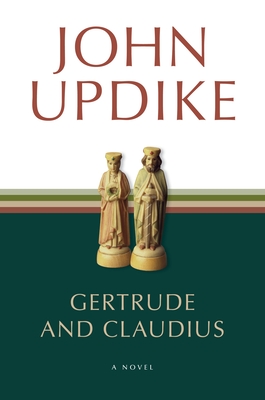
Cover
The main aspect of the novel, or rather its main contribution to the literary realm, is its characterisations. In the play, most of the characters are only as deep as their alotted space in the play and the restrictions of drama will allow. In the novel, however, each character is given a history and a multi-faceted personality presented through their actions, thoughts and utterences and not least through what is said about them by other characters. Claudius, for one, is seen by most of the characters as a shifty, though resourceful character. He is represented mainly in comprarison with his brother, Old Hamlet. He is characterised, through a combination of fear and respect, by the other characters and also by Updike more directly as the traditional fairy tale hero king, much like in the play. The mediating character here is Gertrude. Although the role of narrator shifts through the novel, the space given her, her intimate relations to both brothers and her position as the only fully developed female character in a court of men modifies the view granted in the play. Also, by voicing the largely silent and appendant female character of Gertrude, Updike can introduce new perspectives and depths of character into the story. Her position and reflections on personality provides an aspect to the characters which Shakespeare in his male dominated environment was unable to provide.
It is also worth noting how Claudius is the only character in the novel whose basic ambitions remain ambivalent to the reader. Whereas the agendas of most of the characters both in the play and in the novel are fairly easy to grasp, we never really know if Claudius really wants the throne, Gertrude or both. We are also never really sure how he sees his fellow characters; is Gertrude the love of his life or just a tool for usurping the throne? The shiftiness of his character is emphasised towards the end where he on one page sees his fate linked to Polonius and on the next more drastically feels the need to remove him. Interestingly, the only other character that comes close to this is Hamlet, who in the novel (which does not offer as mych insight into his mind as the play does) appear haughty and somehow beyond reach for his surroundings.
The nomenclative measures Updike takes is another testimony to his skill. The characters change names through the three sections of the novel; Gerutha to Geruthe to Gertrude, Feng to Fengon to Claudius, Horwendil to Horvendile to Hamlet, Amleth to Hamblet to Hamlet and Corambus to Corambis to Polonius. In the last section, the change of names is partially explained through Fengon and Corambis entering new roles at the court and therefore adopting latin names. However, the changing names are a reference by Updike to earlier versions of Hamlet in which the characters wore different names, the first section to Saxo Grammaticus' "Historica Danica" from around 1200 and the second to Belleforest's "Histories Tragiques" from 1576. (In the First Quarto, some of these names still linger. On the First Quarto see earlier post.)
In the same vein, several textual references are made to Shakespeare's play. Not only the names, but several references to situations and lines from the play figure in direct or rewritten form in the novel. The sensitive relation to Norway, the reason why Hamlet idolises his father and why the crown is so intimately associated with Gertrude are amongst the issues that are built on the play. In addition several lines from the play are repeated in the novel, not necessarily by their original speakers. The last sentence in the novel, for instance, "All would be well" refers both to Hamlet's line "All is not well"(Act I,ii) and Claudius' line "All may be well" (Act III.iii). Elsewhere, Gertrude says "Elsinore has been a dungeon to me" (p.94) which of course reflects Hamlet's "Denmark's a prison", spoken to Rosenkrantz and Guildenstern in Act II,ii. Finally,one of my favourite quotes, indeed the one referred to in the sub-title of this blog, is reshaped on the novel's 38th page. "There's a divinity that shapes our ends, Rough-hew them how we will" (Act V,ii) becomes "There's a shape in things, fiddle and fuss however we will around the edges."

John Updike (2000), portrait in The New Yorker
Furthermore, Updike seems to have studied his European history. His contextual references are telling and manifold, referring to the Holy Roman Empire, Frankish battles against the Moors in Spain, Crusades, Genoa's struggles with Pisa over Corsica and Sardinia as well as a number of local references to Danish Kings. For someone with more time on their hands the temporal setting in the novel could probably be quite accurately pegged based on these references. Perhaps this is a fitting topic for a future post...
It is worth noticing how Updike not only seems to respond to different versions of Hamlet in his novel, but also to critical approaches to the play. In empowering Gertrude he responds to both Feminist and Psychoanalytic criticism and in incorporating lower social strata as well as contextual signifiers he reflects the attitudes of Marxist and Historical criticism. This testifies to a rigid and extensive pre-productive study process on Updikes part, and one which is surely reflected in the positive reception of this acclaimed novel.
Finally, on a more personal note, having read a number of texts which build on and expand aspects of the original play (such as Tom Stoppard's "Rosenkrantz and Guildenstern are dead", Matt Haig's "The Dead Fathers' Club" and this novel), I have experienced one of the fascinating properties of literature. Literature seems to me to be but wordly shadows of some eternal stories waiting to be manifested though never fully copied through these shadows. While Shakespeare is widely acclaimed for having written "universal" plays, I find him to be no more than another link in the chain of representations, albeit perhaps a particularly guilded or golden one. Shakespeare, it must be remembered, was only in a limited sense an originator relying on a number of cultural aspects of what I called, rather pompously, an eternal story. I find it not only impossible, but also undesirable to even attempt to make a full, comprehensive and exact copy of this eternal story. However, each attempt to recreate a morsel of it, such as those mentioned above, has an receptively emotional and culturally multiplying value. To put it more bluntly, each new piece of literature or indeed any cultural expression adds to the amount of joy not only of the play but of the general cultural expression of this eternal story. Also, continuing the trend of "bluntness", each new addition creates a basis for new additions, heading like branches on a tree in new directions widening our perception of the eternal story in ways we did not think possible.
This is
for me
part of the allure of literature.
Sources: Updike, Johnn: Gertrude and Claudius, New York, 2001, http://images.indiebound.com/979/006/9780449006979.jpg, http://www.newyorker.com/images/2009/02/09/p465/090209_r18201b_p465.jpg, last visited 25.2.2010
Tuesday, 23 February 2010
Blast from the Past: "World's Wittiest Lonely Hearts Ads"
In 2006 I added this news story to my MSN space. It bears revisiting:
World's Wittiest Lonely Hears Ads
A collection of witty and eccentric lonely hearts ads from the London Review of Books have been brought together for a new book.
David Rose, the review's advertising director who launched the personal ads in 1998, is behind They Call Me Naughty Lola.
It features some of the most brilliant and often absurd ads from what's been billed as the world's funniest - and most erudite - lonely-hearts column.
Here's a selection of the funniest, beginning with the one which inspired the book's title:
'They call me naughty Lola. Run-of-the-mill beardy physicist (M, 46).'
'I've divorced better men than you. And worn more expensive shoes than these. So don't think placing this ad is the biggest comedown I've ever had to make. Sensitive F, 34.'
'List your ten favourite albums... I just want to know if there's anything worth keeping when we finally break up. Practical, forward thinking man, 35.'
'Employed in publishing? Me too. Stay the hell away. Man on the inside seeks woman on the outside who likes milling around hospitals guessing the illnesses of out-patients. 30-35. Leeds.'
'I like my women the way I like my kebab. Found by surprise after a drunken night out and covered in too much tahini. Before long I'll have discarded you on the pavement of life, but until then you're the perfect complement to a perfect evening. Man, 32, rarely produces winning metaphors.'
'My ideal woman is a man. Sorry, mother.'
'Your buying me dinner doesn't mean I'll have sex with you. I probably will have sex with you, though. Honesty not an issue with opportunistic male, 38.'
'Not everyone appearing in this column is a deranged cross-dressing sociopath. Let me know if you find one and I'll strangle him with my bra. Man, 56.'
'Are you Kate Bush? Write to obsessive man (36). Note, people who aren't Kate Bush need not respond.'
'Stroganoff. Boysenberry. Frangipani. Words with their origins in people's names. If your name has produced its own entry in the OED then I'll make love to you. If it hasn't, I probably will anyway, but I'll only want you for your body. Man of too few distractions, 32.'
'Ploughing the loneliest furrow. Nineteen personal ads and counting. Only one reply. It was my mother telling me not to forget the bread on my way home from B&Q. Man, 51.'
'Mature gentleman, 62, aged well, noble grey looks, fit and active, sound mind and unfazed by the fickle demands of modern society seeks...damn it, I have to pee again.'
'Slut in the kitchen, chef in the bedroom. Woman with mixed priorities (37) seeks man who can toss a good salad.'
'Bald, short, fat and ugly male, 53, seeks short-sighted woman with tremendous sexual appetite.'
'Romance is dead. So is my mother. Man, 42, inherited wealth.'
Source: http://www.ananova.com/news/story/sm_2057296.html, last visited 23.2.2010
World's Wittiest Lonely Hears Ads
A collection of witty and eccentric lonely hearts ads from the London Review of Books have been brought together for a new book.
David Rose, the review's advertising director who launched the personal ads in 1998, is behind They Call Me Naughty Lola.
It features some of the most brilliant and often absurd ads from what's been billed as the world's funniest - and most erudite - lonely-hearts column.
Here's a selection of the funniest, beginning with the one which inspired the book's title:
'They call me naughty Lola. Run-of-the-mill beardy physicist (M, 46).'
'I've divorced better men than you. And worn more expensive shoes than these. So don't think placing this ad is the biggest comedown I've ever had to make. Sensitive F, 34.'
'List your ten favourite albums... I just want to know if there's anything worth keeping when we finally break up. Practical, forward thinking man, 35.'
'Employed in publishing? Me too. Stay the hell away. Man on the inside seeks woman on the outside who likes milling around hospitals guessing the illnesses of out-patients. 30-35. Leeds.'
'I like my women the way I like my kebab. Found by surprise after a drunken night out and covered in too much tahini. Before long I'll have discarded you on the pavement of life, but until then you're the perfect complement to a perfect evening. Man, 32, rarely produces winning metaphors.'
'My ideal woman is a man. Sorry, mother.'
'Your buying me dinner doesn't mean I'll have sex with you. I probably will have sex with you, though. Honesty not an issue with opportunistic male, 38.'
'Not everyone appearing in this column is a deranged cross-dressing sociopath. Let me know if you find one and I'll strangle him with my bra. Man, 56.'
'Are you Kate Bush? Write to obsessive man (36). Note, people who aren't Kate Bush need not respond.'
'Stroganoff. Boysenberry. Frangipani. Words with their origins in people's names. If your name has produced its own entry in the OED then I'll make love to you. If it hasn't, I probably will anyway, but I'll only want you for your body. Man of too few distractions, 32.'
'Ploughing the loneliest furrow. Nineteen personal ads and counting. Only one reply. It was my mother telling me not to forget the bread on my way home from B&Q. Man, 51.'
'Mature gentleman, 62, aged well, noble grey looks, fit and active, sound mind and unfazed by the fickle demands of modern society seeks...damn it, I have to pee again.'
'Slut in the kitchen, chef in the bedroom. Woman with mixed priorities (37) seeks man who can toss a good salad.'
'Bald, short, fat and ugly male, 53, seeks short-sighted woman with tremendous sexual appetite.'
'Romance is dead. So is my mother. Man, 42, inherited wealth.'
Source: http://www.ananova.com/news/story/sm_2057296.html, last visited 23.2.2010
Academic Earth
Some univertities embrace the possibilities of internet to a larger extent than others. While regular, physical attendance at lectures is still required in most forms of higher education, a number of American Universities have contributed to a digital lecture bank at http://www.academicearth.org/.
Consisting mainly of Ivy League contributors, the California based webpage philanthropically aims to provide quality lectures (availiable for grading) for free. It is based on what you might call intellectual donations, lectured volunteered by professionals with permissions from their respective institutions.
Consisting mainly of Ivy League contributors, the California based webpage philanthropically aims to provide quality lectures (availiable for grading) for free. It is based on what you might call intellectual donations, lectured volunteered by professionals with permissions from their respective institutions.

The Academic Earth Homepage (click to enlarge)
At the moment, Academic Earth offers 23 subjects, some with quite comprehensive lecture series. These range from literature studies to computer science and media studies. Taking the lectures do not give any official recognition of competence, but they give valuable insight into whatever interests you.
In an age of insatiable search for profit and lacking knowledgeability it is comforting to find a reliable, non-profit vehicle of education like Academic Earth. I, for one, plan to spend parts of my summer vacation taking the psychology and literature lessons.
In an age of insatiable search for profit and lacking knowledgeability it is comforting to find a reliable, non-profit vehicle of education like Academic Earth. I, for one, plan to spend parts of my summer vacation taking the psychology and literature lessons.
A weather forecast out of the ordinary
My sister watches "Super-news", a special news service for kids. At intervals, some fascinating news stories and film clips appear and when they do, she seeks them out and forewards them to me. So, courtesy of my sister and "Super-news":
My favourite parts are the way he says "an associated cold front brushes the south... but... AAAAAH!" and the very Aussily pronounced "mentally scarred".
My favourite parts are the way he says "an associated cold front brushes the south... but... AAAAAH!" and the very Aussily pronounced "mentally scarred".
Subscribe to:
Posts (Atom)