Wednesday, 17 February 2010

Sleep Talkin' Man

I've promised everyone I would post a link to this blog without following up, so now it's time to deliver the goods.

A lady in England, Karen, married her childhood sweetheart, Adam, only to discover that Adam was quite talkative in his sleep. Not only that, he seems to be most creative in his sleep as well. So she started recording his sayings and posting them on the web at the following address:

http://www.sleeptalkinman.blogspot.com/

Now, before I post my favourite quotes, there are a couple of things you should know about Adam. Firstly, Adam watches lots and lots of nature shows on TV. Secondly, Adam sleeps soundly and wakes abruptly without properly transitional phases in-between and, finally, he is not like that when he's awake...

After a painful process of elimination, I have found that my favourite quotes are as follows:

"Badger tickling... proceed with caution"

"Buttcheeks ahoy! Thar she blows! Yeah, you can't be a pirate if you haven't got a beard. I said so. My boat - my rules"

"Really? If you can pee that high, DEFINITELY join the fire brigade. Yah."

"Oh, don't worry, dear. The spot doesn't make you ugly. No no no. The rest of your face, now THAT makes you ugly. The spot's just a highlight."

"I made this picture using pasta... Fuck you, it IS artistic!"

"Snail fiddling is not an occupation I'd be proud of. You dirty fucker."

"The stain, the stain. How am I going to explain that fucking stain?... Oh bollocks."

"My badger's gonna unleash hell on your ass. Badgertastic!"

and finally:

""You can stop clapping now if you want. Really. You'll need your energy for
cheering me later. Shhhhhhhh. shhhhhhhh."

[yelled upon waking] "COCK HUNTER!"

Karen's note: This was all early in the morning. The
batteries had run out on the recorder, so it was like the old days, I was
furiously typing, trying to keep up. I'm pretty sure that's the "clapping" that
Adam was referring to. So, meanwhile, I'm still typing my brains out, and he's
going "Shhhhhhhh. shhhhhhh."

Also, just after he shouted "COCK HUNTER"
and woke up, he looked at me with fear in his eyes and said, "um, did I just
shout cock hunter?" It's been worrying him ever since."

Monday, 15 February 2010

Who Wants to be a Millionaire?

If I had any pluck, I would invest in apps. "What are apps?", you ask, silently. Apps, or applications, are special programs for your phone which give you maps for the strange city you are in, let you follow the temperature, the news, the stock market or the hit lists. The app is what makes your smart phone smart. There is an app for everything and everyone buys apps. The market is estimated to be worth around $ 6 million this year, which is a doubling of last year.

Just a few of the iPhone apps

At the moment Apple is hogging most of the shares through their iPhone app flora, but recently 24 operators and smart phone manufacturers have joined forces in the Wholesale Application Community (WHAC). They want to create an open platform to compete with Apple, a platform from which Apple is excluded. As it is, only iPhones take the Apple apps, but WHAC envisions a more adaptable set of apps which not only gives the customer more choice and vitalises smart phone development, but also diversifies the market and promotes competition.

For now, smart phones constitute only about 20% of the market, but as both the smart phone and the app market is expanding at an astonishing rate, it would probably be a good idea to invest in such stocks as early as possible.

Sources: CNN, http://www.textually.org/textually/archives/images/set3/apl10.jpg, last visited 15.2.2010

News for Rabbits

In 1979, four years after Monty Python's infamous dreaded "Killer Rabbit of Caerbannoch", President Jimmy Carter was fishing in Plains, Georgia. He then had a brush with wildlife:

Click for larger image

It is not known whether the rabbit was a Russian assassin in scuba and lepal disguise. However, rabbits are known to cause some damage if cornered. For those who doubted the veracity of the species, this image was supplied:

Here, the malicious rodent can be seen fleeing in wild-eyed disarray after its aquatic assault on the American Primus Inter Pares had been foiled by the latters fervent paddle-bashing.

In other news for rabbits, this time of a newer date:

In 2007, North Korean dictator Kim Il Sung promised his people a giant bunny in every pot. Embassy employees in Germany approached Karl Szmolinsky, famed giant rabbit-breeder, requesting his service for "feeding the population". He sold them four female and two male German grey giants and later visited them so see how the project was coming along.

The proud breeder flaunts his prime product.

The North Korean people is living mainly on foreign aid, due to Kim Il Sung's misguided policies which, in the 90's, lead to widespread famine and 2 million dead.

The rabbits are so large, they find it hard to hop and they have to be fed like pigs to get this big which begs the question; why not breed pigs instead?

Only the binge-drinking, Elvis-loving dictator knows.

Sources: http://www.nypost.com/p/news/international/item_MYiR9TQoubljVYJlsBsmLM;jsessionid=6F46F25BCCB20CD7C0A062929B411B34,

http://cayankee.blogs.com/cayankee/2007/02/jimmy_carters_n.html,

http://schema-root.org/technology/agriculture/livestock/rabbits/breeds/german_grey/german_grey_rabbit.jpg,

http://news.google.com/newspapers?nid=2202&dat=19790830&id=vlsyAAAAIBAJ&sjid=B-gFAAAAIBAJ&pg=6689,5285665, last visited 15.2.2010

Sunday, 14 February 2010

Janet Adelman's ""Man and Wife Is One Flesh": Hamlet and the Confrontation with the Maternal Body" Revisited

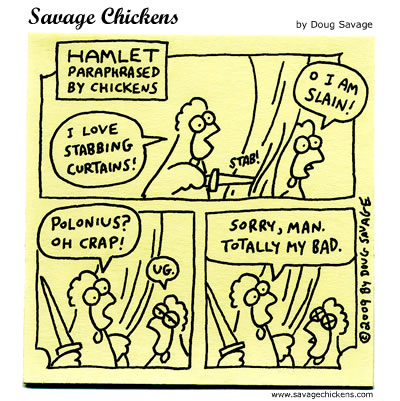
Janet Adelman, in her psychoanalytic approach to Hamlet, studies the role of Gertrude, Hamlet's mother, in the play. However, she starts by explaining how Hamlet fails to identify with his idealised dead father. Contrasting himself to Old Hamlet and doing the same with Claudius, his stepfather, makes him by extension associate himself with Claudius. Psychoanalysts take great delight in uncovering layers, some would say constructing layers, within literature and Adelman sees this conflict as a mere superficial layer. She moves on to examine the idea of the contaminated female body in Hamlet.

She uses the soliloquy in act 1 scene 2 (1.2.129-159) as a symbolic manifest, dividing the father figure into a positive sun god, Old Hamlet and a negative, incestuous satyr, Claudius. Then, likening Gertrude to an unweeded garden, the queen or rather her sexuality becomes the grounds for comparison for Hamlet, Adelman claims. The soliloquy is the textual evidence for Adelman's theory that the conflict in the play is more about the mother's remarriage as a vehicle of her sexuality than the loss of a father. The idealised father and Hamlet then become products of Gertrude's sexuality and the play proceeds with Hamlet's efforts to desexualise his mother, thus freeing himself and his father from her corruption. It is also worth noticing how her sexuality becomes synonymous with death; it lead to the death of Old Hamlet, Hamlet himself is its product with the terminal implication of origin and Old Hamlet's death also kills Hamlet's identity and leaves him in the power of his mother. Death becomes the sexualised Gertrude's legacy to her son.

However, the idealised father also played a role in relation to this sexuality. Adelman's response to this is to point out how Hamlet deflects the guilt of the father figure on Claudius while attributing most of the positive aspects to Old Hamlet. Later in her article, she also points out how Old Hamlet supposedly was able to control her sexuality (referring to the same soliloquy), making life livable for Hamlet. Therefore, the presence of the sexualised mother threatens the ideal of the idealised father being in control. Furthermore, it threatens to eliminate the oppositions between past and present, Old Hamlet and Claudius (both being subject to her sexuality) and the virginal image of Old Hamlet's wife and the "unweeded garden" of Claudius' wife. Finally, Hamlet's obsessing over Gertrude's appetite liken him to Claudius, the negative father image.

The central theme of the play, then, becomes the contamination of the female sexuality. Hamlet sees his mother's sexuality as a force which threatens his concepts of the world and causes its corruption. Adelman refers to what she calls "the deep fantasy of the play" (p.268) in which man is corrupted through contact with the corrupting female (seeing the act of intercourse as an origin of corruption) and in which the blame for the murder of the idealised father pass from Claudius to Gertrude. Her display of love becomes synonymous with murder, so much so that Claudius' political ambitions are subjugated to it and Hamlet in the closet scene (3.4) labels Gertrude the active murderer:

QUEEN GERTRUDE: O, what a rash and bloody deed is this!
HAMLET: A bloody deed! almost as bad, good mother, As kill a king, and marry with his brother.
QUEEN GERTRUDE: As kill a king!
HAMLET: Ay, lady, 'twas my word.
Hamlet initially fears the male under the power of a female and therefore withdraws into his antic disposition, an introvert mode of existence where he, the male and (ideally) the image of the idealised father, is in control and able to effectively impact the world around him without being affected.


Dreaming of men

The main threat, according to Adelman, is Gertrude as she is the only sexualised female in the play. Her role is as a part of Hamlet's psyche (the other) with which he must come to terms. This is done in the closet scene where Hamlet gets Gertrude's seeming assent to stay chaste and honour Old Hamlet's memory. When this is done, Hamlet can focus on his real objective, the revenge. He has remade his mother, "ended" her sexuality and thus brought both his father and himself to prominence, displayed on stage as the Ghost leaving, supposedly for heaven.

Adelman claims that the objective of revenge had been secondary to the objective of reform throughout the play. This is exemplified through the play-within-the-play, which seems more suited to catch the conscience of a queen rather than a king, and also to the fact that the opportunity for revenge in act 3 scene 3 is presented as a minor digression in the play. Also, it seems that Hamlet is unable to act and come to terms with his situation until the point where he resolves his issue with Gertrude. Whether or not she is actually reformed is not clearly stated, but the play is ambiguous enough to at least suggest so.

This psychoanalytic criticism of Hamlet exemplifies in my opinion the best and the worst aspects of psychoanalytic literary criticism. It wonderfully expands the characters and the relations between them. It helps us investigate motivations and inhibitions and discover patterns of behaviour. However, it uses prefabricated theoretical structures and imposes them on the play, sometimes with minimal texual evicence. At times, the textual passages referred to are so open to interpretation that any approach would be able to build a case on them. In this case, the image of the unweeded garden is a minor metaphor of with a number of possible signifieds, and it is an image which is not repeated in any form which cannot be linked to a number of other images. It thus forms a large theoretical structure on an inconsistent and insufficiently broad basis. In this way, the article can be seen as providing much of its own fundament, building theories on theories and drawing conclusions from its own conclusions. There is, for instance, nothing in the text's imagery, characteristics and plot to justify the statement that "the mother's body brings death into the world because her body itself is death" (p.271). This is a product of psychoanalysis rather than a thorough reading of the text. Also, the theory that Hamlet's accusing his mother of active murder is a bit far fetched, as the textual evicence points towards another meaning. The Ghost had told Hamlet that "the serpent that did sting thy father's life Now wears his crown" (1.5.38-39) and to leave his mother alone. Bearing in mind that Claudius has now entered Hamlet's consciousness more urgently as he thinks he is the one dead behind the arras, it is highly unlikely that Hamlet would be unclear as to the mother's role in the murder. The role of the player queen in the play-within-the-play further argues this point. It is more probable that "as kill a king and marry with his brother" is a simple postulation of the royal couple's individual crimes. Here, psychoanalytic criticism builds itself a theory so alluring that it obscures what is actually stated in the text.

Finally, the central theory of the reform of Gertrude could simply be nothing but a generical requirement. Hamlet being a tragedy, Gertrude could not die a "bad" woman. That would lessen the effect of her death. The fact that one could come up with an alternative, valid theory to explain the necessity of her reform in such a simple stroke is a testimony to the artificiality of much of psychoanalytic criticism.

Sources: http://www.savagechickens.com/images/chickenpolonius.jpg and http://www.wsu.edu/~delahoyd/shakespeare/hamlete.jpg, last visited 14.2.2010
Janet Adelman in Shakespeare, William: Hamlet, ed. by Wofford, Susanne L., New York 1994

Saturday, 13 February 2010

Revision game

Before starting on their preposition handout this week, Sportyclass got to play a revision game I invented during the first sleepless hours of a cold, pre-solistice night.

During the introductory grammar course this fall we touched on word groups such as nouns, verbs, adverbs and adjectives. Before reentering the confusing realm of grammar we had to refresh some of these groups.

Sportyclass is particularly partial to competitions, so I decided to use this form for revision, why not. Building on a game we played in the army, I had the whole class stand on their desks. Then I proclaimed that the whitebord (forward) was nouns, the windows (left) were verbs, the door (right) was adjectives and the back was adverbs.

The idea was for the students to turn towards the word group they thought each of the words I was to pronounce belonged to. I had, beforehand, printed out a number of examples of each word group so I would have the posibility to concentrate on choosing words of appropriate difficulty. If a student turned the wrong way, he or she would have to get down from his or her desk and watch the game from their chairs.

Initially I thought I would need one or two pairs of eyes to help me, but this proved unnecessary since we were in quite a large room (using the height rather than the width of the room). However, I found it necessary to limit the time available for pondering by counting down from a few seconds, further adding to the excitement.

It all went really well. No students fell off their desks, and everyone watched those who were left implicitly registering the word group of each given word. By altering the tense of verbs, the degree of adverbs and adjectives, altering between singular and plural nouns and so on, I also managed to have them repeat the properties of each class, and all in a kinestetic and playful environment.

The students politely asked for grammar revisions. Twice.

Tuesday, 9 February 2010

Open Endings

I hate open endings!

This would be much easier

If I didn't love them

Monday, 8 February 2010

Fear-inducing, Fascinating Ophelia

This spring I am studying Hamlet. Extensively. This includes not only a thorough analysis of the characters but also various critical approaches to both them and the play. It seems, as anticipated, that the feminists are mainly concerned about Ophelia. Ophelia is Hamlet's girlfriend who is told by her fater Polonius and her brother Laertes to stay away from him and to "Be somewhat scanter of [her] maiden presence; Set [her] entreatments at a higher rate". This drives Hamlet to reject her which in turn drives her mad. Later it is told by Hamlet's mother Gertrude that she has fallen in the water and drowned, whereupon Laertes kills Hamlet.

What is particularly interesting about Ophelia is the way she has been subject to constantly changing interpretations even though there is not really all that much to interpret. These have at times been rather ridiculous, but some give interesting glimpses into human nature and even French fashions. "How is this, Sir Bob?". Well, it comes about as follows...

The play was first performed about 1600. In 1603 a printed version known as the "First Quarto" or the "Bad Quarto" was published, presumably by an actor bootlegging it. (Theories point to the one playing Marcellus since his lines are the ones most true to the other versions). Then, in 1604, the official "Second Quarto" was published, and finally the "Folio" version was published in a "Best of"-publication in 1623, seven years after Shakespeare's death. All three versions differ in various respects, though not so much in respect to Ophelia. What is interesting, though, is two contextual pieces of information.

Firstly, at the time there were concerns about the male characters being too unmanly. When Laertes cries over Ophelia's death he has to say "when these are gone, the woman will be out", on other words, his tears are an aspect of femininity which he has to rid himself of. Also, while Ophelia was originally played by boys, Hamlet was the only heroic male of Shakespearean drama who was repeatedly played by actresses (following the middle of the 17th century). Secondly, as Ophelia was portrayed as innocent and naive, Shakespeare could have a little joke on her through Hamlet. In Act 3, Scene 2 we find this dialogue (110-113):

OPHELIA: I think nothing, my lord.
HAMLET:
That's a fair thought to lie between maids' legs.
OPHELIA:
What is, my lord?
HAMLET:
Nothing.
As it turns out, "nothing" was slang for the female genitalia in Elizabethan time, which just goes to show how the Renaissance had blessed Shakespeare's contemporaries with enhanced powers of observation as well as refined language. This also puts Shakespeare's "Much Ado about Nothing" in rather a new light.

Then came the 18th century with its Neo-Classicism and their emphasis on self-control, respectability, seemliness and decorum. Ophelia became curiously self-controlled for a madwoman. Originally singing rauncy songs and throwing flowers about (deflowering herself, hm-hm-hm), she now wore a white dress, loosely organised hair, strategically placed wildflowers and an attitude of dignified suffering. How on earth they were supposed to imagine her climbing a tree and falling/jumping into the river in a manner consistent with this representation, I do not care to imagine. (By the way, the jury is still out on the question of suicide mentioned above).

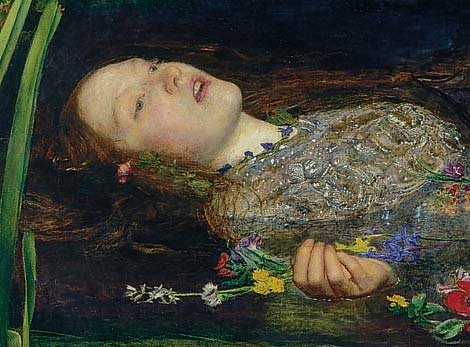
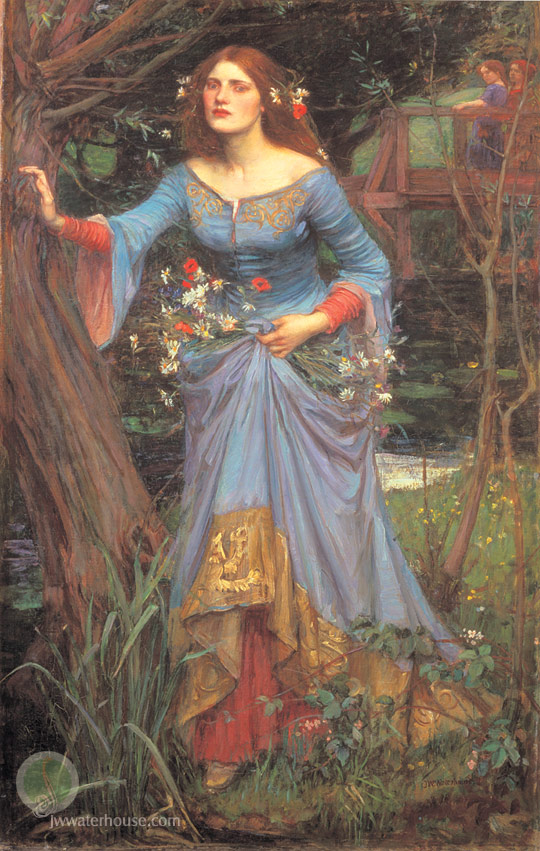
In the Victorian 1800's with all its repressed creative madness, Ophelia became a channel for all kinds of weird behavior. Pre-Raphaelite Romantic painters such as J.W. Waterhouse, Arthur Hughes and J.E. Millais discovered that the death of Ophelia not being actually enacted during the play allowed them to impose their own perspective on the scene. Thus, a number of highly sensual, flowery depictions of nymph-like, watery sirens were made, allowing the Victorians to give vent to their repressed sexuality through the appreciation of art and literature.


As if this was not enough, the invention of photography presented new opportunities for weirdness. Ophelia mad, and her version of madness (flowers, wild hair, flowing garments etc.) was becoming the standard way of presenting madness, that is, mad women were expected to derss and act like Ophelia. This was taken a step further with the introduction of photography. Dr. Hugh Welch Diamond, working in mental asylums such as the Surrey Asylum and Bethlehem ("Bedlam"), claimed that being photographed could cure madness. He then dressed up his patients as Ophelia and had them pray as he photographed them. His photos may have inspired the French Jean-Martin Charcot, who in addition to taking pictures of his patients hypnotised them and had them perform roles from Shakespeare.

In 1827, a young Irish actress called Harriet Smithson took Ophelia to new levels during a performance in Paris. She dressed in a black veil in which he stuck some straws. She also made a few hortocultural additions to her hairdo. Following a most unorthodox performance, including a cross made of flowers on stage, her straw-interwoven costume became the inspiration of the Paris fashion milieu. This is why old ladies today wear capes with patterns of coloured straw in them.
Finally, the 20th century arrived with its explicit focus on sexuality (thanks a lot, Freud!). While a large bed was added as a prop in the closet scene of the play, theories of Oedipus complexes and incestous relationships in Hamlet abounded. Ophelia was resexualised and the most extreme, Freudian theories argued that Ophelia had an incestous, Oedipal relationship to Polonius, parallel to that of Hamlet and Gertrude. Other creative critics invented a past for Ophelia, involving child molesting, unfaithful knights raping and killing her friends and Ophelia experiencing several different consecutive forms of mental illness.
The best version, however, and in my opinion the best example with which to conclude this article, is Melissa Murray's play "Ophelia". This was performed in 1979 by the English women's theatre group "Hormone Imbalance". In this play, Ophelia becomes a lesbian, runs off with a serving maid and joins a Danish guerilla commune. You cannot possibly get better drama than that.

Sources: Shakespeare, William: "Hamlet", ed. Wofford, Susanne, New York, 1994
Pictures: http://preraphaelitesisterhood.com/wp-content/uploads/2007/09/ophelaimillais.jpg and Link, last visited 8.2.2010