Showing posts with label Music. Show all posts

Friday, 10 May 2013

The Quality of Copies

I have a question for you. If availability and price were not an issue, which would you choose:

  1. An original painting or a reproduction?
  2. A concert with your favourite band or a local cover band?
  3. The Twilight/ Lord of the Ring trilogy or the films based on them?
  4. An Armani suit/ Louis Vuitton bag or a Chinese copy?
  5. Attending Woodstock in August 1969 or hearing your parents talk about it?

My guess is you chose the first alternative more often than not. Also, I wager your argument for doing so was that the first is better, but why is that? What makes an original better than a copy, and is the original really what you think it is?

Original and Copy

When a painting is being made, it represents reality. When your local cover band performs, they play already existing songs. The films adapt the readily available books, the Chinese copies mimic the originals and your parents tries to present reality as it was in 1969. The arts' role in representing reality emphasises the distinction between original and copy and Graham Allen, professor of literal and cultural theory at University College Cork, examines the nature of this relationship in Intertextuality in reference to Walter Benjamin's seminal essay The Work of Art in the Age of Mechanical Reproduction:

In an age before the mass publication of books, possession of an individual text was extremely rare and of enormous value. The prices still paid for original classic paintings also attest a residual attachment on contemporary society to the aura of the original work of art. Technological society, however, is dominated by reproductions of original works. The signed copy of the novel may be preferable to the unsigned copy, an original painting by Van Gogh may seem priceless, attendance at a dance performance may seem preferable to viewing it on video, but in contemporary society our experience of these and all other arts are generally of their technological reproductions. New artistic media of the twentieth century such as film, video and television, are, indeed, based on technological methods of reproduction. The aura which surrounds The Mona Lisa or the eight-century Book of Kells in Trinity College Library, Dublin, is unavailable to, and indeed an irrelevance for, these kinds of art forms (i). 
Allen, of course, neglects to mention that by their very nature the original painting by Van Gogh, the Mona Lisa, the Book of Kells and even the dance performances are themselves reproductions. Each of them mimics either natural entities, persons, stories probably already in existence, a dance script or an earlier performance.

Not original

With licence to copy (©)

Dance, by accompanying and illustrating originals such as music, narration or in hunter gatherer societies the movement of animals, necessarily has to imitate an original through body movement (ii). The hunter gatherer would accompany the rhythm of a primitive drum and dance to give a representation of his genesis myth through body movement. He might also dance to mimic the hare which he caught earlier. In these cases, the hunter gatherer tries to adapt cultural expressions like music into another art form, reproducing music and myth narration as dance, or he is imitating the world, reproducing the movement of its animals.

Still not original

The signed copy of a novel is arguably just that, a copy. The Mona Lisa is a static reproduction of the visage of a real person and the Book of Kells is a reproduction of Christian sacred documents and a summing up of contemporary religious discourse.

The basic argument still stands, though, because in the original-reproduction dichotomic relationship the original is the source from which the reproduction borrows and as such truly original within that relationship. Likewise, by being a part of a cultural context, the original appears as a segment of reality, however many earlier sources it may have imitated. Thus, art is always to some extent a copy of reality and it is this copy which is generally encountered in contemporary society.

Copy of Kells

This, in a simple and applicable form, is exemplified by news media. As soon as we do not experience an event first hand, we miss reality because any other way of becoming aware of the event after its passing has to be through a reproduction. This could be in terms of someone having experienced the original event and then reproducing it by narrating his or her experience. Alternatively, it could be in terms of a newscast reporting a real event, its content and form edited and adapted in order to be presentable through a different medium, film (iii). As representative for an age of multi-media, this latter case is symptomatic for the emergence of the field of adaptation where narratives are adapted into new technological modes of expression.

"Do I have an original thought in my head?"

So if everything is inspired by something and nothing is original, does that mean that everything is of poorer quality than some mythical source?

Well, it depends on how you look at it.

A pessimist would say that you cannot create anything new and original and by borrowing, willingly or unwillingly, you make a patchwork which is less coherent and less consistent and therefore of lower quality. Since you cannot help drawing your inspiration from your experience, you are doomed to reproduction and, at best, repetition. The pessimistic approach is expertly exemplified in the opening monolgue of Adaptation:


The pessimist would say that the film takes what you read in the book, leaves out the bits it finds irrelevant and adds bits it thinks should be there, like music or moving images. The chances of these corresponding with what you would think appropriate are slim to none and the rest of the audience faces similar odds. Because of this gap between priorities and between expectations, any new cultural product would in fact be a poorer one.

An optimist, on the other hand, would argue that the novelty is in the combinations. By combining cultural products, like film music, moving images and a story from a novel, the new film could be so much more than each individual product could. You would understand the book differently, listening to the song would never be the same again and seeing that actor play out his part would modify the way you look at both him and other films in which he has appeared.

The optimist would say that because everything is a copy and because you cannot do anything without copying several other copies, you make something original. There are so many elements which inform your creation process, that the likelihood of all those elements having been put together before is as small as the pessimist's priority odds.

An original copy

Let us revisit the list we started with.

  1. The reproduction would be more than a poorer imitation of the painting. It would include all the colours, all the interpretations and experiences of the reproducing painter and all the history of the original painting.
  2. The cover band concert would update the original song and give it a local flavour. It would reflect not only each musician, but also the musical tradition of the area in addition to what were there "originally".
  3. The trilogies could only communicate through symbols or the occasional static image. The films, on the other hand, can tell you things through the sequence of images, through what's in these images and through sound (which includes music, noises, dialogue, voiceover etc.). These would give you experiences you could never create based on just the text.
  4. The Chinese imitations would use different materials, different techniques and would probably be more affordable and available. This combination would greatly expand the impact and implications of all these products.
  5. By combining the Woodstock experience with all their history after the event, nostalgia and modern sensibilities, your parents will have created a new Woodstock, one which is different from the one they actually experienced. In time, you might tell your children about Woodstock and your story will, with almost complete certainty be a different one.
Oh no! That cannibal from Sin City, Jonathan Safran Foer, has got the ring!

The copy, therefore, is original because it is a combination which did not exist before. Considering it as a poorer version just because it is based on something else might have more to do with the psychological fear of being wrong, of having backed the wrong thing. Psychologist Elliot Aronson wrote:

Far from being a sign of intellectual inferiority, the capacity to err is crucial to human cognition. Far from being a moral flaw, it is inextricable from some of our most humane and honorable qualities: empathy, optimism, imagination, conviction, and courage. And far from being a mark of indifference or intolerance, wrongness is a vital part of how we learn and change. Thanks to error, we can revise our understanding of ourselves and amend our ideas about the world (iii).

So next time you catch yourself thinking that someone has destroyed your favourite book or piece of music, keep Aronson's words in mind and then ask yourself what you have lost, why it was precious and what you have gained.

What do you think? 

How do you react to copies like a film adaptation of your favourite book? Is a copy always poorer than the original? Does the knowledge that you probably are not creating anything new as such take the fun out of creative work? If so, why? Is the alternative that we stop producing cultural expressions or should we open the floodgates and create for the lowest common denominator? Make your contribution to the discussion!


Comments on The Tale of Sir Bob are always welcome!

Sources: (i): Graham Allen: Intertextuality, 2nd edn (Oxford and New York: Routledge, 2011): 176
(ii)Ann C. Albright and Ann Dils (eds.): Moving History/ Dancing Cultures: A Dance History Reader (Middletown, CT: Wesleyan University Press, 2001): 119-120
(iii): Elliot Aronson: The Social Animal (New York: Worth, 2012)
Pic1, Pic2, Pic3, Pic4

Wednesday, 25 April 2012

General Taylor

Recently, I've been trying to arrange music for my local choir using Sibelius 6. I tried arranging General Taylor, a sea shanty, for tenor and bass but it turned out that I had laid the tenor too high and the bass too low. I expect they will have to converge somewhere, but I do not have time to do the necessary adjustments. If any of my readers would like to do so and use the arragnement with his or her local choir, you are perfectly welcome to do so.


Below is the arrangement as is. You can click the image to zoom.Please contact me through this post if you would like me to send the .sib file.


Saturday, 26 November 2011

Vivaldi and Beckett Brought Together

Last night, there was a storm. A chaotic rumble of branches flying about, windows and doors slamming and gusts of wind hammering my abode. Today, the wind is all but gone and a cold, greyblue silence has taken its place. One which calls for subdued reflection.

It is under these conditions that two works of art appear to me as profoundly appropriate. The first is the second movement from Antonio Vivaldi's Gloria (RV589), Et in Terra Pax. This peaceful piece of music beautifully complements a scene from Samuel Beckett's one-act, one-character play Krapp's Last Tape. A melancholy and disillusioned old man, Krapp, sits by himself listening to diary-like tapes he recorded when he was younger remembering episodes with joy, but also regret. The scene included here is one of those episodes.

My suggested method for reading this is allowing Et in Terra Pax to run in the background while reading the scene. If you would like to read Beckett's complete play, you can find it here.


"

TAPE

--Back on the year that is gone, with what I hope is perhaps a glint of the old eye to come, there is of course the house on the canal where mother lay a-dying, in the late autumn, after her long viduity (Krapp gives a start), and the--(Krapp switches off, winds back tape a little, bends his ear closer to the machine, switches on)--a-dying, after her long viduity, and the--

Krapp switches off, raises his head, stares blankly before him. His lips move in the syllables of "viduity." No sound. He gets up, goes back stage into darkness, comes back with an enormous dictionary, lays it on table, sits down and looks up the word.

KRAPP

(reading from dictionary). State--or condition of being--or remaining--a widow--or widower. (Looks up. Puzzled.) Being--or remaining? . . . (Pause. He peers again at dictionary. Reading.) "Deep weeds of viduity" . . . Also of an animal, especially a bird . . . the vidua or weaver bird . . . Black plumage of male . . . (He looks up. With relish.) The vidualbird!


Pause. He closes dictionary, switches on, resumes listening posture.

TAPE

--bench by the weir from where I could see her window. There I sat, in the biting wind, wishing she were gone. (Pause.) Hardly a soul, just a few regulars, nursemaids, infants, old men, dogs. I got to know them quite well--oh by appearance of course I mean! One dark young beauty I recall particularly, all white and starch, incomparable bosom, with a big black hooded perambulator, most funereal thing. Whenever I looked in her direction she had her eyes on me. And yet when I was bold enough to speak to her--not having been introduced--she threatened to call a policeman. As if I had designs on her virtue! (Laugh. Pause.) The face she had! The eyes! Like . . . (hesitates) . . . chrysolite! (Pause.) Ah well . . . (Pause.) I was there when--(Krapp switches off, broods, switches on again)--the blind went down, one of those dirty brown roller affairs, throwing a ball for a little white dog, as chance would have it. I happened to look up and there it was. All over and done with, at last. I sat on for a few moments with the ball in my hand and the dog yelping and pawing at me. (Pause.) Moments. Her moments, my moments. (Pause.) The dog's moments. (Pause.) In the end I held it out to him and he took it in his mouth, gently, gently. A small, old, black, hard, solid rubber ball. (Pause.) I shall feel it, in my hand, until my dying day. (Pause.) I might have kept it. (Pause.) But I gave it to the dog.

Pause

"

Friday, 11 November 2011

Another Song for the Exhausted

My Fridays are always harrowing. If you were to say; "Look at that fellow, Sir Bunbury, he is a nervous wreck" you wouldn't be far off. Giving lectures for hours on end can really take it out of a poor blighter. In these situations, T Rex' We Love to Boogie and particularly this youtube rendition is like ointment to the wearly limb.

Friday, 23 September 2011

The Literal Versions of Songs You Know

Whereas most types of film show scenes connected by some form of plot, music videos stand apart. In these, the song which they accompany fills the same adhesive role which means that this visual presentation can be read in quite a different way than the song itself. Just watch:


Saturday, 3 September 2011

A Literary Love Song

Here is Justin Edvards from The Consultants' literary love song with my best transcription of the lyrics underneath. If you should happen to know the author in the third verse, please tell me e.g. in a comment.


Too Jane Austentatious

One wet Wednesday afternoon
I saw my lending library lovely.
Raven haired she stamped my Raymond Chandler,
my heart dissolved

So I stayed ‘till closing time,
I reckoned that to make her mine
I’d have to woo her bookishly;
I Danielle Steeled my resolve.

Oh, library lady, would you care to join me for a cup of T.
S. Eliot or perhaps a glass of Barbara Pyms and lemonade?
Harper Lee she gazed at me then locked the door
I took her Wilkie Collins in my hand and we began to promenade.

This was certainly a Mills & Boon,
had I been too Thomas Fool-Hardy?
But she shared my feeling
I was pretty damn Bernard Shaw.

So I told her how I felt,
she dimmed the lights I dropped my Orwells,
she grasped my dictionaries,
we fell J.K. Rowling to the floor

But the library hall is no place to seduce
it’s too Jane Austentatious.
It would be Rudyard Kipling there
we might get seen, Tom Clancy that

So we crept into the reference
section out of view
and there I lay down with my library lady
on the coconut mat

Oh, she said, this itchy floor
is bound to give me a thesaurus.
I built a bed of Mary Wesleys
upon which we could uncoil

With the photo copier light on,
for a pillow, Michael Crichton,
tenderly she placed her hands
upon my Conan Doyle.

She was Oscar Wilde in bed,
like a leaping Salman Rushdie head-
long into passion, personally I was
a bit too Jonathan Swift.

I could have done with a hardback edition
rather than my floppy old paperback Grisham,
but I gave her the full Brontë
And she didn’t seem too miffed.

But our affair had never lasted.
Something went Kingsley Amis.
She found another lover
with a larger print than mine

I was Graham Greene with envy
I was Somerset Maugham and I felt empty,
but my Philip Roth soon passed,
one day I ceased this futile cry.

Now I stand here feeling sorry,
grasping my Daphne du Mauri-
er a Dewey Decimal teardrop
on my cheek once more.

Occasionally I reminisce
and an Evelyn Waugh escapes my lips
remembering by Dickens
our lending library floor.

Friday, 2 September 2011

More Singing Heads of State

I have previously blogged about Putin singing Blueberry Hill. As it turns out, most heads of state like to sing, and some more publicly than others. Here are my favourites:

Clinton Sings "Imagine" by John Lennon


Silvio Berlusconi Sings Some Unclear Songs


And another one, with the song starting at 0:55


Hugo Chavez Sings While Playing the Maracas, Then Sings Some More

Monday, 22 August 2011

Mark Knopfler's Songs About War

There are many ways to write songs about war. Some songs are angry, some are eager but fortunately most can be understood as anti-war songs. Of these, Mark Knopfler is one of those who in my opinion is most successful in describing the powerlessness of those who suffers because of war; soldiers, civilians and those left behind. This is a collection of his best anti-war songs with a reference to the war in question where applicable.

Brothers in Arms
from the album with the same name, one dedicated to an anti-war agenda.


The Man's Too Strong
from the same album. Who is the man? A father would be an authority figure. So might a dictator. In a family, there might be no distinction.


Done With Bonaparte
from the solo album Golden Heart. This clearly refers to the Napoleonic wars, but notice how the last verse foreshadows the Second World War.


Remembrance Day
from his most recent album, Get Lucky. This is about the First World War as indicated through the title and specific topical wording. This song beautifully concludes the list, showing how small the individual becomes in war and how great our obligation to the victims should be.

Wednesday, 13 July 2011

Putin Singing

This is the single most scary and probably coolest thing I've witnessed this year. One of the most powerful, ruthless and through and through Russian men in the world singing. It is like the reported use of Barney the Dinosaur's "I Love You"-song for "enhanced interrogation" purposes. Enjoy and tremble!


Update (2.9.2011): See more heads of state singing in this post.

Friday, 3 June 2011

The Story of Another Riff

In September and December 2010, I presented a number of songs built over the same riff. This is quite a common phenomenon. Easy to come by just about sums it up. The good thing about that is that if you like one of the songs, you will probably like a few of the others. In this spirit, I'd like to present the story of another riff.

The Beatles - Blackbird

Written by Paul McCartney early one morning in 1966 in the back garden of his house at Cavendish Avenue.


Eva Cassidy - American Tune

Composed by Paul Simon in 1975 and sung by Eva Cassidy, it is difficult not to be moved by American Tune.


Keb' Mo' - I'll Be Your Water

From the 2005 album Suitcase, the song is an interesting mixture of the melodies of Blackbird and American Tune and the motif of Simon and Garfunkel's Bridge Over Troubled Water.

Saturday, 28 May 2011

Top Three Dances

These are the three dances I would most like to learn and the music that made me want to learn them. See if you aren't similarly inclined:

1. Jive

This is the dance as presented by Stefano Di Filippo and Anna Melnikova, 2008 World Champions. The dance itself lasts from 1:40 to 3:43.


I would very much like to dance the jive to this song from Hairspray:


2. Argentine Tango

I want to dance the tango like Deborah Quiroga and Carlos Barrionueva did at the 2006 Mundial de Tango in Buenos Aires...


so I can dance to this, Gotan Project's Mi Confesion:


3. West Coast Disco

Just want to expand my swing skills to cover more musical genres such as these:

Benji and Heidi, as posted before:


and the Canadian West Coast Swing champions, Myles Monroe and Tessa Cunningham.


Sources: as given

Thursday, 14 April 2011

To Rise Above the Beasts - Derek

The fourth post in the To Rise Above the Beasts series introduces Derek Paravicini, a musical savant.

Derek

Derek Paravicini was born too early. Because of this, oxygen treatment was administered which left him blind and autistic with learning disabilities. He seemed destined for a hard life outside society, byt Derek is world famous. His disadvantages have made him a musical genius.

Being unable to see and originally having difficulties understanding speech, his skills tended towards the musical side. He has absolute pitch and is able to repeat any piece of music he has ever heard. In addition, he is able to merge styles and songs in quite an extraordinary manner. Starting off, let's watch him play Flight on the Bumblebee on two pianos.


Friday, 8 April 2011

Great "Death Bys"

From time to time you come across different "Death Bys". Some are shouted theatrically. Those are the best. Others appear on a button or in a song but they are still amusing. These are my three favourite "Death Bys".

3. Toy Story 3 - Death by Monkeys

In Toy Story 3, the evil Dr. Porkchop presses a button labelled "Death By Monkeys", which releases a barrel of monkeys from his ship. These monkeys then proceed to stretch our heroes in amazing concert. Thus:


2. In Johnny Cash' The Man Who Couldn't Cry - Death by Stretchmarks 

Intriguing idea in a great and very humourous song.


Those who did not quite make the top three:

Death by Chocolate (click to view)
Death by Spoon (click to view)

1. Futurama, Episode 3x5: Amazon Women in the Mood - Death by Snu-Snu

What is snu-snu and why would the shouted horrible, fabulous sentence of "DEATH by SNU-SNU!" bring joyous exclamations to the lips of any victim? Watch and concur!


Sources: Pic1, Pic2, Pic3

Tuesday, 5 April 2011

Don McLean's "Crossroads"

This is one of the most beautiful songs I know. It features on Don McLean's iconic album American Pie. The lyric and intensely personal nature of the text moves me in a way very few poems do. Apart from W.H. Auden's Funeral Blues, there would be hard to find any verse that echoes within me like Crossoads does. Like Coleridge and Shelley's aeolian harp.

And just like their aeolian harp and, indeed, the first poems this text is accompanied by music. Don McLean has his song presented in simple vocals and solitary piano which combine to give us as complete an experience as we can possibly wish for.

Don McLean - Crossroads
I’ve got nothing on my mind:
nothing to remember,
Nothing to forget,
and I’ve got nothing to regret,

But I’m all tied up on the inside,
No one knows quite what I’ve got;
And I know that on the outside
What I used to be, I’m not
anymore.

You know I’ve heard about people like me,
But I never made the connection.
They walk one road to set them free
And find they’ve gone the wrong direction.

But there’s no need for turning back
`cause all roads lead to where I stand.
And I believe I’ll walk them all
No matter what I may have planned.

Can you remember who I was?
can you still feel it?
Can you find my pain?
can you heal it?

Then lay your hands upon me now
And cast this darkness from my soul.
You alone can light my way.
You alone can make me whole once again.

We’ve walked both sides of every street
Through all kinds of windy weather.
But that was never our defeat
As long as we could walk together.

So there’s no need for turning back
`cause all roads lead to where we stand.
And I believe we’ll walk them all
No matter what we may have planned.

Wednesday, 9 March 2011

Paul Hogan's Peter Pan

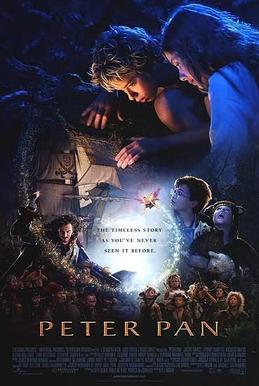
“All children grow up except one”. Paul Hogan’s 2003 film Peter Pan re-envisages J.M. Barrie’s classic play about a boy who do not want to grow up and retrieves the story from the Disney universe. In the first film in several years retelling the story Hogan updates its visual representation not only using all the tools modern animation can provide, but also maintaining a darker atmosphere than that presented in the previous, Disney version. This combines to make Peter Pan one of the most enjoyable and refreshing films in a year dominated by Disney films like Finding Nemo and Pirates of the Caribbean.

Peter Pan Poster

As in the original play the Darling children, Michael, John and most significantly Wendy flies with Peter Pan from their nursery window to Neverland, leaving their parents, the dog Nana and their Aunt Millicent behind to despair. Neverland, an island populated by Indians, pirates, fairies, mermaids and crocodiles, turns out to be every child’s dream. On the island, the Darling children are constantly amazed by all its wonders and have many adventures most of which arise in dealing with Peter Pan’s nemesis, Captain Hook. 


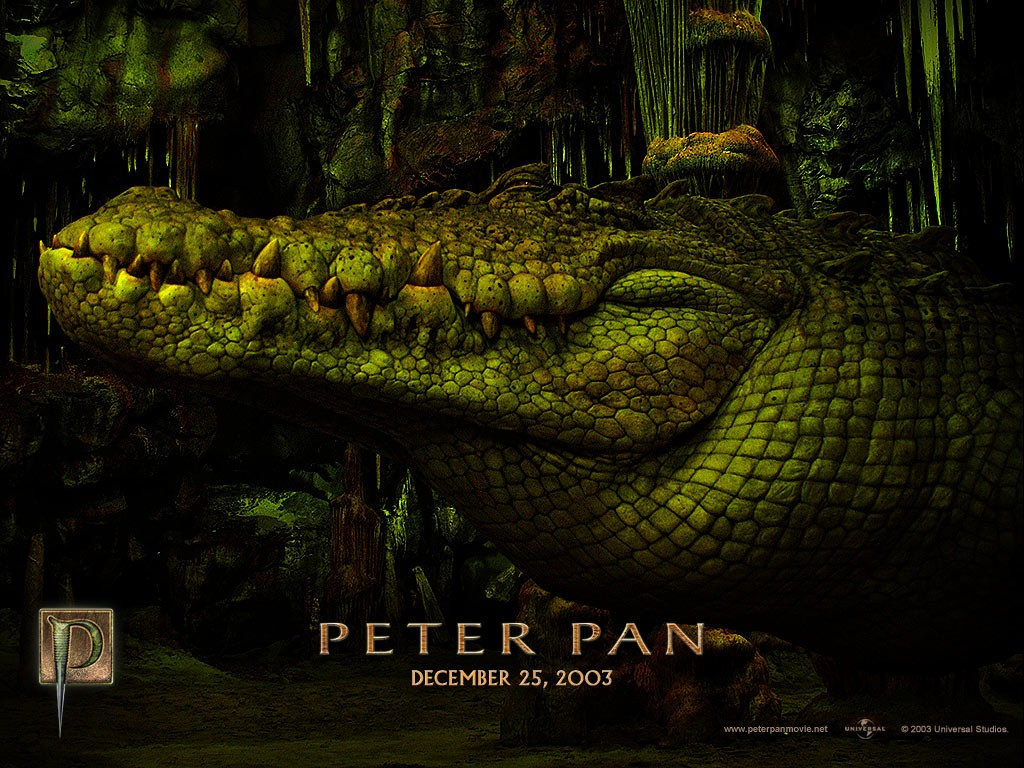
The film has all the original characters, and then some. Peter Pan, played by Jeremy Sumpter and the pirate captain Hook, excellently portrayed by Jason Isaacs are still at odds just like Peter’s fairy companion Tinker Bell, played by Ludivine Sagnier and just referred to as Tink, is consumed by jealousy towards the debuting Rachel Hurd-Wood’s Wendy. The crocodile, which was somewhat scary in the original play and a source of comedy in the Disney film, has become a 25 metre animated monster, a nightmarish dinosaur always looming below the surface. The feared Hook’s fear of this grim force of nature would render the audience almost sympathetic to him, had it not been for Smee’ contribution of disarming comic relief. In addition, whereas the original Mr. and Mrs. Darling were somewhat ludicrous in their fussy maturity this has been transferred to the newly introduced Aunt Millicent whose wish for Wendy to become a woman must be the primary motivation for her and her siblings to join Peter on his trip back to Neverland.

A subtle difference

The introduction of Aunt Millicent and the magnification of the crocodile is, however, not the only aspects of the characters Hogan has changed. Whereas the sinister side of Hook was toned down by the Disney version, it has been reinstated with a vengeance here. A cruelly malevolent, though suave, nature, a sickly complexion, an array of vicious looking hooks and a callous attitude towards murder makes Hogan’s Hook a far cry from the comical Disney version as he kills off crew members left and right in his hunt for Peter Pan. The brilliance of Jason Isaacs’ portrayal is, of course further bolstered by his portrayal of the harmless and whimsical Mr. Darling who traditionally has been played or voiced by the same actor.

Jason Isaacs as Mr. Darling and Captain Hook

In addition, Hogan introduces a sexual tension between Peter and Wendy. Previous versions have shown no more than a faint suggestion of romance, whereas Hogan makes this a central element to the plot. Sumpter, dressed in a revealing attire appropriate for a character named Pan, and Hurd-Wood as 14- and 13-year-olds brilliantly portray the conflicting and yet enthralling feelings of young teen. After all, who would have thought that a kiss could be that important?

The sexual tension and the cruelty of Hook works together with a stylistic modernising of the story to make it available to an older and more modern audience. The animation of flying, of crocodiles and islands, of fairies and weather maintains makes the film visually appealing while still maintaining the aura of fantasy. The appeal of the Peter Pan story has always been the opportunity to lose oneself in role play and make-believe and this, in combination with more grown-up elements such as the above mentioned sex and violence, should cater for the interests of an audience between child- and adulthood.

The score, made by James Newton Howard, is also updated and very much in a fitting genre. Its upbeat tracks resemble the music from young adult films of the 90’s. In addition, the influence of the score of the two years older Harry Potter and the Philosopher’s Stone is apparent. The music serves to enter the film into a new generation of fantasy, adventure and animated films, which is further emphasised in the tracks borrowed from other films to accompany the trailer. While meant to resemble the film’s future score, the tracks from Muppet Treasure Island (1996) and Chicken Run(2000) further underlines Hogan’s intention to appeal to a specific audience.


There is, however, two elements that somewhat lessens my enjoyment of this film. First of all, the twelve minute intro, consisting of some familiar but several new plot elements, establishes Wendy’s significance but delays Peter Pan’s entrance. Impatient cinema goers like myself would find this tedious and unnecessary. Hogan’s target audience is not watching the film for drawn out descriptions of Mr. Darling’s social awkwardness or Aunt Millicent’s folly. They want to see flying, swordplay, crocodiles and romance. Similarly, the Tink character is given too many comical aspects. In a film where several characters are given added traits and consequence, Tink is just not central enough to merit the role she is given in the film. Originally intended to be fully digitally animated, she here becomes a mere nuisance and a diversion from more compelling characters.

The success of Hogan’s Peter Pan resides much in its vivid characters and modern use of camera and animation. The type casting of Jason Isaacs (from the Harry Potter movies) and  the always comical Richard Briers as Smee helps modernise and enter the story into a new generation of films. Although the film did not achieve the credit it was due on release, following blockbusters like Lord of the Rings: The Return of the King and Pirates of the Caribbean: The Curse of the Black Pearl, the story of the playful child in opposition to boring, foolish or evil adults has been given new and compelling garbs which make it a film well worth watching. 

Update: The entire film can be found here (choose the following parts to the right).
Another update: This is my article on the relationship between the film and the original play.

Sources: 1, 2, 3 or as given

Saturday, 19 February 2011

German Sing-along - Die Partei hat immer Recht

The German hits just keep coming, do they not? After Papa Trinkt Bier and Staplerfahrer Klaus and the German Indian Winnetou, it is time for something a bit more pompous. This is the state sponsored Die Partei hat immer Recht - the party is always right - with the full text and my translation underneath so we can all join the chorus.

Ready? Eins, zwei, drei ...


Thanks to IA!

Friday, 4 February 2011

Pulp Fiction in 11,5 Minutes

Been a while since you last saw Quentin Tarantino's decidedly best film? If you have 11.28 minutes to spare, search no further. Let us start off with a brief summary of the dialogue and the plot.


Following this display of the brilliance and versatility of certain words, emjoy a coulple of memorable scenes. First up is the lovely dance scene with Mia Wallace (Uma Thurman) and Vincent Vega (John Travolta) (which, incidentally, is a homage to this dance from Fellini's 8 1/2).


The sad demise of Marvin:


The history of a heirloom as narrated by Captain Koons (Christopher Walken):


The perilous future of Zed, currently under the watchchful glare of Marsellus Wallace (Ving Rhames):


A clarification of techincal terminology as well as a short biographical note on Zed:


And finally, Misirlou as performed by Dick Dale & The Del Tones in A Swinging Affair (1963). Incidentally, the background for the odd name can be found in the original Greek traditional.


Sources: Youtube

Tuesday, 1 February 2011

Three Songs I Wouldn't Expect Myself to Like

It' strange how music can move you, as ABBA pointed out. Sometimes, the most surprising songs might become favourites. It seems it is possible to enjoy music immensely without being part of the culture it describes or from which it sprang. This is the case with the following three songs. Although they are the outsiders of my playlist the their exclusivity make them all the more dear to me.

(If you are easily offended by strong language you probably should have stayed the fuck away from this post.)

Enjoy!


Kid Rock's Cowboy from Devil Without a Cause


Green Day's 21 Guns from 21st Century Breakdown


Michael Zager Band's single Let's All Chant
(this one is probably due to its featuring in Watchmen)

Wednesday, 5 January 2011

Four Chords from Seven Years Ago and a Difficult Word

Following the blog posts on the life of a riff, this seems like a natural sequel. The badly named Axis of Awesome, Australia's most tolerated musical comedy trio, has pointed out what most musicians have noticed but not entirely thought through. A lot of pop music consist, at least in central segments, of a sequence of just four chords; D, A, Hm and G or a transposed version of these.


Although the trio might not be awesome in the original sense (as explained by Eddie Izzard - see above), they deserve credit for clearly and efficiently stating the point and compiling such a long list of songs, not to mention how they spread hope to lonely, unattractive but clever bachelors with a worn out instrument.

Here is their four chord song:


They could have done worse, wouldn't you say?

Source: 1

Sunday, 19 December 2010

The Story of a Riff - Update

In September I traced the career of a riff in The Story of a Riff - Bullet in the Fever Stranglehold Train. I showed how the riff had travelled from Savoy Brown's Hellbound Train (1972) via Ted Nugent's Stranglehold (1975) and U2's Bullet the Blue Sky (1987) to Fever Dog from the 2000 film Almost Famous.

Now, it seems like Led Zeppelin's When the Levee Breaks predates these. From the 1971 album Led Zeppelin IV, it bears distinct similarities to Bullet the Blue Sky, especially thanks to John Bonham's drum and Robert Plant's vocals. As one commentator wrote on the youtube page for the vid below;

" This song is like having sex in a fast car while eating ice cream and everything's glitter and confetti

It is interesting, though, to see how the Zeppelin version again is an adaptation of a 1929 blues. It was written by Kansas Joe McCoy and Memphis Minnie after the Great Mississippi Flood of 1927, but is impossible to come by due to Sony Music forcing their copyright. However, this makes the riff 81 years old, by the last count.


For the other 4 versions of the riff, see the first post.